CEAM’s Ultimate Guide to School Choice in Missouri
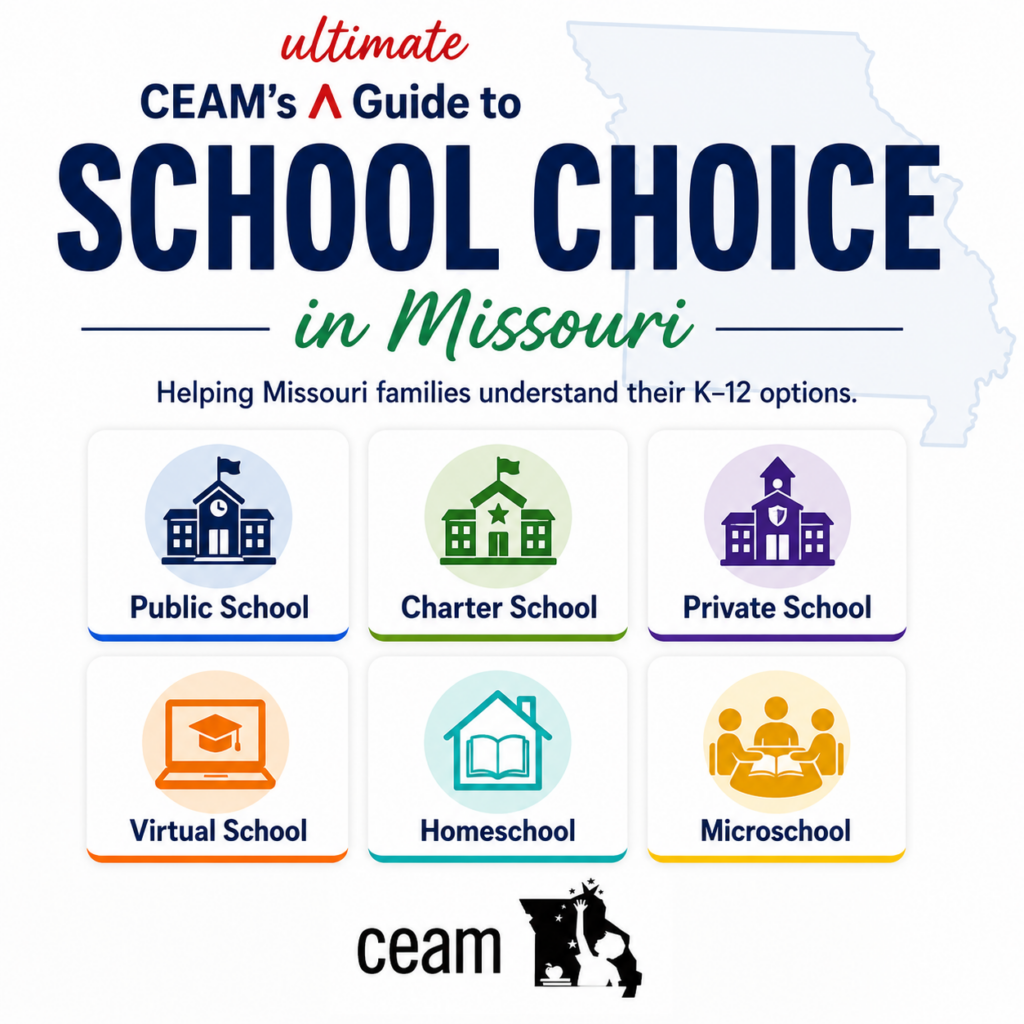
Helping Missouri families understand their K-12 options.
This guide was created to help parents understand their K-12 options, compare school types, and find practical answers to common questions about K-12 education in Missouri.
Choosing the right educational environment can be a major decision, and many families have questions as they explore their options. CEAM works to help Missouri families better understand available educational opportunities, scholarship programs, and school choice resources.
Quick Navigation
Step 1 — Understand Your Options
Learn about public, charter, private, virtual, homeschool, and microschool options available to Missouri families.
Step 2 — Compare School Types
Understand differences in academics, school culture, transportation, flexibility, admissions, and support services.
Step 3 — Explore Financial Assistance
Learn how MOScholars and other scholarship opportunities may help make private education more affordable.
Step 4 — Frequently Asked Questions & Next Steps
Review common parent questions and connect with additional CEAM resources.
Step 1 — Understand Your Options
School Comparison Chart
| School Type | Tuition | Admissions | Flexibility | Transportation |
|---|---|---|---|---|
| Traditional Public School | Free | Assigned by residence | Moderate | Usually provided |
| Charter School | Free | Open enrollment or lottery | Moderate | Varies by school |
| Private School | Tuition-based | School-specific admissions | Often higher flexibility | Varies |
| Virtual School / MOCAP | Often free | Program-specific | High | Not applicable |
| Homeschool | Parent-directed | Parent-directed | Very high | Not applicable |
| Microschool | Varies | Program-specific | Often flexible | Varies |
1. Traditional Public Schools
Traditional public schools are tuition-free schools operated by local school districts. People who live in a school district are able to attend the district school to which they are assigned. Most Missouri students attend the public school assigned to the area where they live.
Public schools may offer:
- transportation,
- athletics and extracurricular activities,
- special education services,
- career and technical education,
- Advanced Placement (AP) and dual credit courses,
- and a wide range of academic programs.
Missouri families can request transfers within their district depending on district policies and available space.
For many students, traditional public schools are an excellent fit. However, some families explore additional options if their child needs a different learning environment, more flexibility, specialized programs, or additional academic or social support.
Traditional Public School Transfer Opportunities
Today, Missouri does NOT have full open enrollment that would allow students to freely attend the district of their choice. Some districts accept tuition from transfer families from outside the district.
Currently, Missouri has no school districts that are deemed UNACCREDITED. If a district became unaccredited due to low performance and other factors, a Missouri law would be triggered that would allow students living in districts classified as unaccredited or provisionally accredited by the Missouri Department of Elementary and Secondary Education (DESE) to have additional transfer options available under that state law.
Some Missouri families may have opportunities to transfer schools either:
- within their local school district,
- outside their assigned district boundaries depending on district policies and available capacity,
- or to neighboring districts in certain circumstances involving district accreditation status.
Transfer opportunities and enrollment policies vary widely across Missouri and may depend on:
- available space,
- transportation,
- grade level,
- district approval,
- application timelines,
- and local enrollment procedures.
Because tuition charges often reflect the district’s per-pupil cost, they can be significant and may exceed tuition at some private schools.
Families should also understand that transportation may not always be provided for transfer students, which can be an important consideration when evaluating school options.
Missouri lawmakers continue to debate broader public school open enrollment proposals that could expand transfer opportunities for families statewide.
Because policies and availability can change, families interested in transfer opportunities should contact schools or districts directly for the most current information.
2. Charter Public Schools
Charter public schools are publicly funded, tuition-free public schools that operate independently from the traditional school district in which it is located..
Missouri charter schools are concentrated primarily in:
- Kansas City Public Schools district boundaries,
- St. Louis City and parts of St. Louis County,
- and, in 2025 the Boone County/Columbia-area expansion was established, though no new schools have opened there yet. One charter school has been approved for opening there..
Charter schools may offer:
- smaller learning environments,
- STEM-focused programs,
- college-preparatory curriculum,
- alternative teaching models,
- and increased flexibility in school operations.
Because charter schools are public schools:
- they do not charge tuition,
- must accept any student that applies,
- use lotteries when applications exceed available seats,
- Must provide special education services.
Availability varies significantly by region, and some schools have waiting lists that are resolved through a lottery system. Families should inquire about enrollment periods and lottery deadlines and act quickly to apply. Most charter public schools in Missouri now use the Common Application.
3. Private Schools
Private schools, sometimes also called nonpublic schools, operate independently and may offer:
- faith-based education,
- specialized curriculum,
- smaller class sizes,
- college-preparatory programs,
- or unique educational philosophies.
Unlike public schools, private schools charge tuition and establish their own admissions policies.
However, Missouri families may qualify for scholarship assistance through programs such as MOScholars, which can help offset approved educational expenses.
Private school costs vary widely depending on:
- location,
- grade level,
- school mission,
- and student services provided.
Many schools also offer internal financial aid programs. The MOScholars K-12 Scholarship Program funds Empowerment Scholarship Accounts that families may use for private school tuition and certain other educational expenses.
4. MOCAP and Virtual Learning
Missouri’s Course Access and Virtual School Program, known as MOCAP, gives Missouri students access to online courses and full-time virtual learning options through approved providers. MOCAP includes both individual virtual courses and full-time hosted virtual programs that are hosted by certain traditional public school districts. Students in full-time hosted MOCAP programs must be Missouri residents and will transfer their child’s enrollment to the host district. Beyond MOCAP, parents have the option to privately pay for a virtual school provider.
Virtual learning may be a good option for students who:
- need flexible scheduling,
- prefer independent learning,
- have health or safety concerns,
- need access to courses not offered locally,
- or thrive with online instruction.
Families should ask:
- Is this a full-time program or a single online course?
- Who teaches the course?
- How much live instruction is provided?
- What support is available if my child falls behind?
- What technology is required?
- How much parent supervision will be needed?
Not all virtual schools operate the same way. It is important to understand how the school looks for the student and how instruction is provided.
For students with disabilities, families should ask additional questions. DESE notes that MOCAP is a virtual program and does not itself provide services requiring in-person contact; services may depend on whether the student remains district-enrolled or is parentally enrolled.
Flexibility and Scheduling
Virtual learning and homeschooling can offer more flexibility than a traditional school day, but flexibility does not mean “less structure.”
Students often need:
- a regular schedule,
- a quiet learning space,
- reliable internet access,
- adult oversight,
- and clear expectations for completing work.
Some students thrive with this independence. Others may struggle without daily in-person routines and teacher interaction.
Parent Involvement Expectations
Parents should expect to be more involved in both virtual learning and homeschooling than they might be in a traditional school setting.
In virtual learning, parents may need to monitor attendance, assignments, technology, communication with teachers, and progress. In homeschooling, parents take direct responsibility for planning and delivering the child’s education.
Before choosing either option, families should honestly consider:
- How much time can an adult dedicate each day?
- Does the child work independently?
- What support will be available if the child struggles?
- How will the family measure progress?
- How will the child stay socially connected?
Student Support Services
Support can vary widely across virtual programs and homeschool arrangements.
Families should ask about:
- tutoring or academic help,
- special education services,
- counseling or mental health support,
- teacher availability,
- communication expectations,
- extracurricular access,
- and transition support if the student later returns to a traditional school.
The right flexible learning option should not only fit a family’s schedule — it should also provide the academic, emotional, and social support the child needs to succeed.
5. Homeschooling
Homeschooling is another option for Missouri families who want to direct their child’s education outside of a traditional school setting.
Missouri law requires home schools to offer at least 1,000 hours of instruction during the school term. At least 600 hours must be in reading, language arts, mathematics, social studies, science, or related academic subjects, and at least 400 of those 600 hours must occur at the regular home school location.
Parents who homeschool are responsible for:
- selecting curriculum,
- tracking instructional hours,
- maintaining educational records,
- and directing their child’s education.
Homeschooling may appeal to families seeking:
- individualized instruction,
- flexible scheduling,
- faith-based education,
- alternative learning approaches,
- or customized pacing.
Some homeschool families may also participate in extracurricular or educational opportunities offered through local schools or organizations depending on local policies and state law changes.
The family/student considerations for home-based virtual learning listed above also apply to homeschooling.
6. Microschools
Microschools are small learning environments that often combine elements of traditional schooling, homeschooling, and personalized instruction.
While microschools vary widely in structure, many are designed to provide:
- smaller class sizes,
- individualized learning,
- flexible scheduling,
- hybrid home-and-school learning models,
- and close student-teacher relationships.
Some microschools operate full-time in a classroom setting, while others combine in-person instruction with at-home learning days.
Microschools may appeal to families seeking:
- a smaller learning environment,
- more personalized instruction,
- alternative teaching approaches,
- or greater flexibility than a traditional school setting.
Because microschools differ significantly in curriculum, accreditation, staffing, tuition, and educational philosophy, families should carefully review each program individually.
Parents may want to ask:
- Is the program accredited?
- What curriculum is used?
- How often do students attend in person?
- What are parent involvement expectations?
- Are scholarships or financial assistance available?
- What student support services are offered?
As interest in alternative learning models continues to grow, microschools are becoming an increasingly visible option for some Missouri families.
Step 2 — Compare School Types
Choosing a school is about more than academics alone. Every school has its own culture, learning environment, expectations, and approach to supporting students.
This section helps Missouri families compare educational models and think through which type of environment may best fit their child’s learning style, interests, needs, and long-term goals.
Families often compare schools based on:
- academic programs,
- school safety,
- extracurricular opportunities,
- transportation,
- class size,
- student support services,
- scheduling flexibility,
- and overall school culture.
There is no single “best” school for every child. A school that works well for one student may not be the right fit for another.
Quick Comparison of School Types
| School Type | Tuition | Admissions | Flexibility | Transportation |
|---|---|---|---|---|
| Traditional Public School | Free | Assigned by residence | Moderate | Usually provided |
| Charter School | Free | Open enrollment or lottery | Moderate | Varies by school |
| Private School | Tuition-based | School-specific admissions | Often higher flexibility | Varies |
| Virtual School / MOCAP | Often free | Program-specific | High | Not applicable |
| Homeschool | Parent-directed | Parent-directed | Very high | Not applicable |
| Microschool | Varies | Program-specific | Often flexible | Varies |
Families should remember that every school is different. A school that works well for one child may not be the right fit for another.
Academics and Learning Approaches
Schools may differ significantly in:
- curriculum,
- instructional methods,
- academic rigor,
- class size,
- technology use,
- and how they support different learning styles.
Some schools emphasize:
- college preparation,
- STEM education,
- arts integration,
- career and technical education,
- classical education,
- project-based learning,
- or faith-based instruction.
Parents may also want to explore:
- graduation rates,
- accreditation status,
- Advanced Placement (AP) opportunities,
- dual-credit programs,
- reading and math proficiency,
- and student growth data.
Academic performance is important, but families may also consider whether a school’s teaching approach and expectations align with their child’s individual needs and learning style.
School Culture and Environment
A school’s environment can have a major impact on a student’s experience.
When evaluating schools, parents may want to consider:
- classroom atmosphere,
- student behavior expectations,
- communication with families,
- discipline policies,
- diversity of programs,
- and how students are supported socially and emotionally.
Visiting a school, talking with teachers and administrators, and observing how students interact can often provide valuable insight beyond test scores alone.
Academic Support and Student Services
Students learn differently, and families should understand what support systems are available at each school. Students with learning disabilities, gifted students, and struggling students all need different types of support. Talk to school leaders and teachers to understand what the school is able to provide to meet the needs of YOUR child.
Transportation and Scheduling
Transportation and scheduling can play a major role in determining whether a school is a practical fit for a family.
Transportation policies vary by school and may depend on:
- district boundaries,
- charter school transportation availability,
- private school options,
- and virtual program requirements.
Families should also consider:
- school start and end times,
- before- and after-school care,
- extracurricular schedules,
- and parent transportation responsibilities.
Extracurricular Opportunities
Many families look beyond academics when choosing a school.
Extracurricular opportunities may include:
- athletics,
- music and arts programs,
- clubs and student organizations,
- leadership opportunities,
- career and technical education,
- and community service activities.
Participation opportunities vary widely between schools and may influence a student’s overall school experience and sense of belonging.
Questions to Ask During a School Tour
Visiting a school can help families better understand the learning environment and whether it may be a good fit for their child.
Parents may want to ask:
- How does the school communicate with families?
- What academic supports are available?
- How does the school handle bullying and discipline?
- What extracurricular activities are offered?
- What is the student-to-teacher ratio?
- How are struggling students supported?
- What transportation options are available?
- What does a typical school day look like?
- How does the school support students socially and emotionally?
- How are parents encouraged to stay involved?
- How does the school measure student progress?
- What curriculum is used?
- Are advanced courses available?
- How are struggling students supported academically?
- What opportunities exist for college or career preparation?
- How much homework is typically assigned?
- How does the school communicate academic progress to parents?
- How are struggling students supported?
- What services are available for students with special needs?
- Are advanced learners challenged academically?
- What counseling or mental health resources are available?
- How does the school communicate academic progress to parents?
Families should also pay attention to how welcomed and supported they feel during the visit.
Step 3 — Understand Financial Assistance
For many Missouri families, cost is one of the biggest factors when considering educational options outside of their assigned public school.
While private schools and some specialized programs may involve tuition or additional expenses, Missouri families may qualify for scholarship assistance and other forms of financial aid through the school to which they are applying that can help make alternative educational options more affordable.
This section explains how MOScholars works, who may qualify, what expenses may be covered, and important financial considerations for families exploring school choice options.
What Is MOScholars?
MOScholars is Missouri’s K–12 scholarship program created to help eligible families access educational opportunities that best fit their child’s needs. The program was established by the Missouri General Assembly in 2021 and has expanded significantly since then.
MOScholars operates through approved nonprofit Educational Assistance Organizations (EAOs), which award scholarships to qualifying students using funds generated through state tax-credit contributions.
Depending on eligibility and available funding, scholarships may help cover:
- private school tuition,
- homeschooling expenses – called Family Paced Education (FPE)
- tuition at participating Traditional or Charter Public Schools
- tutoring,
- curriculum,
- educational therapies,
- online learning programs,
- testing fees,
- transportation,
- and other approved educational expenses.
Not all expenses qualify, and reimbursement rules may vary by EAO and program guidelines.
Families should carefully review:
- approved vendor requirements,
- documentation policies,
- reimbursement timelines,
- and expense restrictions before making purchases.
The program is available statewide, although participating schools, scholarship organizations, and funding availability may vary.
Because scholarship funding is limited and demand may exceed available funds, families are strongly encouraged to apply as early as possible and communicate directly with participating organizations about application timelines (typically October through March) and scholarship availability.
Who Qualifies for MOScholars?
Student eligibility is determined by Missouri law and administered through participating EAOs.
Generally, students may qualify if they:
- are Missouri residents,
- are eligible to enroll in a K–12 program,
- and meet at least one qualifying pathway established by statute.
Current eligibility pathways include:
Students with an IEP
Students with an approved Individualized Education Program (IEP) or Individualized Service Plan (ISP) developed under IDEA through your local public school district within the past 36 months may qualify for scholarships regardless of household income.
OR
Income-Qualified Families
Students from households meeting income eligibility guidelines may qualify if they also meet additional criteria such as:
- prior public school attendance,
- entering kindergarten or first grade,
Eligibility requirements, income thresholds, and documentation requirements may change over time, so families should review current program guidance through participating EAOs.
Educational Assistance Organizations (EAOs)
MOScholars scholarships are administered through approved nonprofit Educational Assistance Organizations, commonly called EAOs (aka scholarship granting organizations) that serve as the point of contact for MOScholars families. Families apply for MOScholars through the appropriate EAO and that EAO will be the face of MOScholars to the family.
After deciding on the educational setting (private, homeschool, etc) families will be able to determine the EAO to whom they will apply.
EAOs are responsible for:
- reviewing applications,
- determining eligibility,
- awarding scholarships,
- managing approved expenses,
- and helping families navigate the process.
Different EAOs may:
- serve different regions,
- partner with different schools,
- use different timelines,
- and offer varying levels of support services.
Families should review participating EAOs carefully to determine:
- which schools participate,
- application deadlines,
- required documentation,
- and scholarship availability.
Because funding is limited and demand can exceed available scholarships, many organizations encourage families to apply as early as possible.
Financial Aid and Tuition Considerations
Private school tuition in Missouri varies significantly depending on:
- school type,
- location,
- grade level,
- and available student services.
In addition to MOScholars, some schools may also offer:
- internal financial aid,
- need-based assistance,
- sibling discounts,
- parish support,
- or other scholarship opportunities.
Families comparing educational options should consider:
- tuition and fees,
- transportation costs,
- technology requirements,
- extracurricular expenses,
- and any additional out-of-pocket costs.
Families should also understand that:
- scholarship funding levels may vary,
- awards are not always guaranteed,
- and some schools may still require families to cover remaining tuition balances.
How to Get Started
Families interested in financial assistance through MOScholars or other scholarship programs may want to:
- Research participating schools and programs
- Identify the Educational Assistance Organization (EAO) associated with your choice (private school or homeschool)
- Review current eligibility requirements
- Complete any prequalification or interest forms
- Gather required documentation early
- Apply as soon as the application window opens – be aware that different EAOs operate on different timelines, although Fall is typically an application period.
- Communicate directly with schools and scholarship organizations about deadlines and next steps
Because timelines, eligibility rules, and scholarship availability may change from year to year, families should verify current information directly through participating organizations and official program resources.
Step 4 — FAQs & Next Steps
Find answers to common parent questions and connect with additional CEAM resources.
General School Choice Questions
How does school choice work in Missouri?
Missouri families may have access to several educational options beyond their assigned district school, including charter schools, private schools, virtual learning programs, homeschooling, and scholarship opportunities such as MOScholars. Available options vary depending on where a family lives and the type of program they are exploring.
Can I choose which school my child attends in Missouri?
In some cases, yes. Missouri families may be able to enroll in charter schools, private schools, virtual programs, or homeschool their children. Some districts may also allow transfer opportunities depending on local policies and available space.
What should families consider when comparing schools?
Families may want to consider:
- academics,
- school culture,
- safety,
- extracurricular opportunities,
- transportation,
- student support services,
- scheduling flexibility,
- and overall fit for their child’s needs and learning style.
Charter School Questions
Are charter schools public schools?
Yes. Charter schools are publicly funded, tuition-free public schools that operate independently from traditional school districts.
What is the difference between a charter school and a traditional public school?
Both are public schools and tuition-free, but charter schools operate independently and may use different educational models, curricula, or school structures. Traditional public schools are operated directly by local school districts.
Are charter schools free?
Yes. Public charter schools in Missouri do not charge tuition.
Can charter school students go to college?
Yes. Charter school students can pursue college admission just like students from traditional public or private schools.
MOScholars & Financial Assistance Questions
What is MOScholars?
MOScholars is Missouri’s K–12 scholarship program that helps eligible families access educational assistance for approved educational expenses such as private school tuition, tutoring, curriculum, and certain educational services.
Are there income limits for MOScholars?
Some MOScholars eligibility pathways are income-based, while others may be based on factors such as a student having an Individualized Education Program (IEP). Eligibility requirements can change, so families should review current guidelines through participating scholarship organizations.
How much financial help can families receive through MOScholars?
Scholarship amounts may vary depending on available funding, student eligibility, and the Educational Assistance Organization (EAO) administering the scholarship.
Can MOScholars be used for expenses other than tuition?
In many cases, yes. Approved educational expenses may include tutoring, curriculum, educational therapies, online programs, testing fees, and other qualifying educational services.
Can I afford private school in Missouri?
Private school costs vary widely across Missouri. Some schools offer financial aid or scholarships, and programs such as MOScholars may help eligible families reduce out-of-pocket costs.
Virtual Learning & Homeschooling Questions
Are virtual schools an option in Missouri?
Yes. Missouri families may have access to virtual education programs through MOCAP, district-operated virtual schools, and approved online learning providers.
Is homeschooling legal in Missouri?
Yes. Missouri law allows families to homeschool their children while meeting applicable instructional and recordkeeping requirements.
What support services are available?
Support services vary widely depending on the school, program, or educational setting. Families should ask directly about academic support, counseling services, tutoring, special education resources, and extracurricular opportunities.
Enrollment & Transfer Questions
How long does the application process take?
Application timelines vary by school and program. Some schools have fixed enrollment windows, lotteries, or waitlists, while scholarship organizations may have separate application deadlines.
Can I switch schools during the school year?
Possibly. Midyear transfers may depend on enrollment availability, district policies, transportation, and program deadlines.
What transportation options are available with school choice?
Transportation policies vary significantly depending on the type of school and location. Traditional public schools often provide transportation within district boundaries, while charter, private, and virtual school transportation policies may differ.
Special Education & Student Support Questions
Can students with special needs participate in school choice programs?
Many school choice options may serve students with special learning needs, though services and support levels can vary by school or program. Families should discuss specific support services directly with schools before enrolling.
How do I know if a school is accredited?
Families can ask schools directly about accreditation status and review information through the Missouri Department of Elementary and Secondary Education (DESE) or recognized accrediting organizations.
Need Additional Help?
Choosing the right educational environment can be a major decision, and many families have questions as they explore their options.
CEAM works to help Missouri families better understand available educational opportunities, scholarship programs, and school choice resources.
Families can:
- Explore additional CEAM resources
- Attend informational events or parent workshops
- Learn more about MOScholars and scholarship opportunities
- Connect with participating schools and programs
- Contact CEAM with general questions about Missouri education options
Every child deserves an educational environment where they can learn, grow, and succeed.
Helpful Links:
The National School Choice Awareness Foundation maintains the myschoolchoice.com website. Follow the link and enter your search parameters to get a list of nearby schools to explore: https://myschoolchoice.com/schools-near-me
For help with public school enrollment in Kansas City and St. Louis, check out these:
https://schoolappstl.org/ and https://schoolappkc.org/
To learn more about charter public schools in Missouri, visit the Missouri Charter Public School Association: https://www.mocharterschools.org/
For more about Missouri’s virtual school program, MOCAP, visit the website at: https://mocap.mo.gov/
MOScholars information can be found at CEAM’s informational site: https://showmeschooloptions.org/ or at the Missouri State Treasurer’s website: https://treasurer.mo.gov/MOScholars/
Last Updated: May 2026